
The dynamics of superexcited molecules; basics and application.
Research members: Dr. UKAI Masatoshi
Research fields: Physics, Applied physics, Environmental analyses and evaluation
Departments: Department of Applied Physics, Institute of Engineering
Keywords: Radiation damage to DNA, Self-assembled repair, Recombination of electrons with cluster ions, Superexcited molecules
Web site:
Summary
Radiation effects are the result of relaxation of excess energy in the matter provided in the radiation interaction. In radiological technologies the efficient absorption of energy and the selective induction of reaction are required, where superexcitation of molecules plays an important role. We study the properties of superexcitation and related reactions with the emphasis on the initiation and termination of radiation effects.
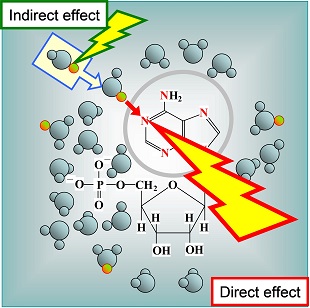
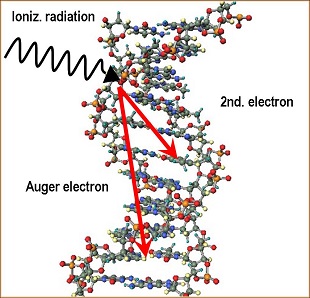
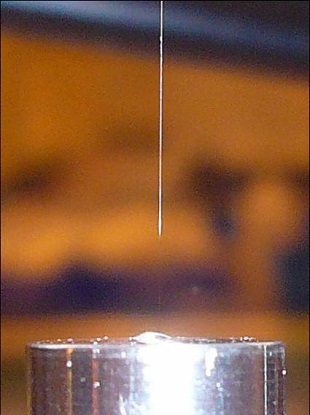
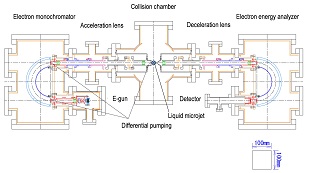
To obtain the insight of damage induction to DNA by the ionizing radiation can channel the way to the control of low-level radiation risk and the medical application of radiation. In addiation to the well known "enzymatic repair" and much faster "chamical repair", self-assmbled repair is proposed as a highly probable hypothesis for the evasion of radiation damage to DNA. The self-assembled repair is the result of a thermal relaxation in a cell, which share the pathway to damage induction. We thus attempt to clarify the molecular mechanism of the thermal relaxation by way of experimental molecular spectroscopy using a synchrotron radiation excitation, high-energy electron scattering, combined with electron spectroscopy and mass spectrometry with the emphasis on the selective primary excitation via superexcitation.
Recombination reaction of electrons with positively charged ions is a terminal reaction of radiation effect, which is important in efficient use of plasmas as well. In atmospheric condition ions readily attract neutral molecules and grow up to cluster ions. We thus conduct experimental investigation for the recombination of electrons with positively charged cluster ions.
Reference articles and patents
1) Nitrogen K-edge x-ray absorption near edge structure of pyrimidine-containing nucleotides in aqueous solution, H.Shimada, H.Minami, N.Okuizumi, I.Sakuma, M.Ukai,1 K.Fujii, A.Yokoya, Y.Fukuda, Y.Saitoh, J.Chem.Phys.,142(2015)175102.
2) Nitrogen K-edge X-ray absorption near edge structure (XANES) spectra of purin-containing nucleotides in aqueous solution, H.Shimda, T.Fukao, H.Minami, M.Ukai, K.Fujii, A.Yokoya, Y.Fukuda, Y.Saitoh,
J.Chem.Phys.141 (2014) 141:055102.
3) Structural changes of nucleic acid base in aqueous solution as observed in X-ray absorption near edge structure (XANES), H.Shimada, T.Fukao, H.Minami, M.Ukai, K.Fujii, A.Yokoya, Y.Fukuda, Y.Saitoh, Chem.Phys.Lett., 591(2014)137-141.
4) Unpaired electron species in calf thymus DNA thin films induced by nitrogen and oxygen K-shell photoabsorption, T.Oka, A.Yokoya, K.Fujii, Y.Fukuda, M.Ukai, Phys.Rev.Lett., 109(2012)213001.
Contact
University Research Administration Center(URAC),
Tokyo University of Agriculture andTechnology
urac[at]ml.tuat.ac.jp
(Please replace [at] with @.)